Top 5 AI Ad Generators in 2026 for SEO Keyword Expansion
Discover the top 5 AI ad generators of 2026 for SEO keyword expansion. Learn how to use SEO Keyword Rank Tracker, Jasper,...
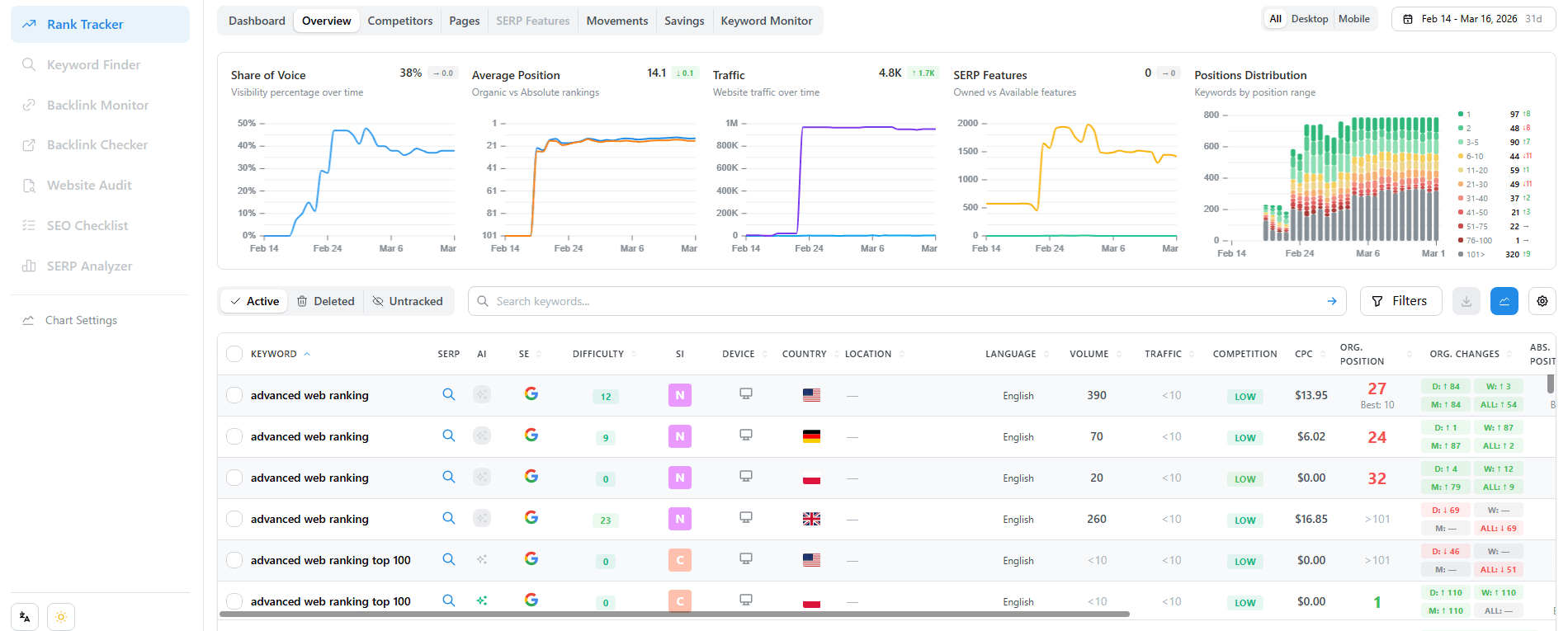
Monitor where your keywords appear in search, how positions shift over time, which pages are winning visibility, and where practical SEO action is needed next. Built for teams that need ranking movement to be easy to read and useful to act on.
The value is not just knowing a position. It is seeing how that position changed, which page is attached to it, where the result appears by device or location, and what deserves action next.
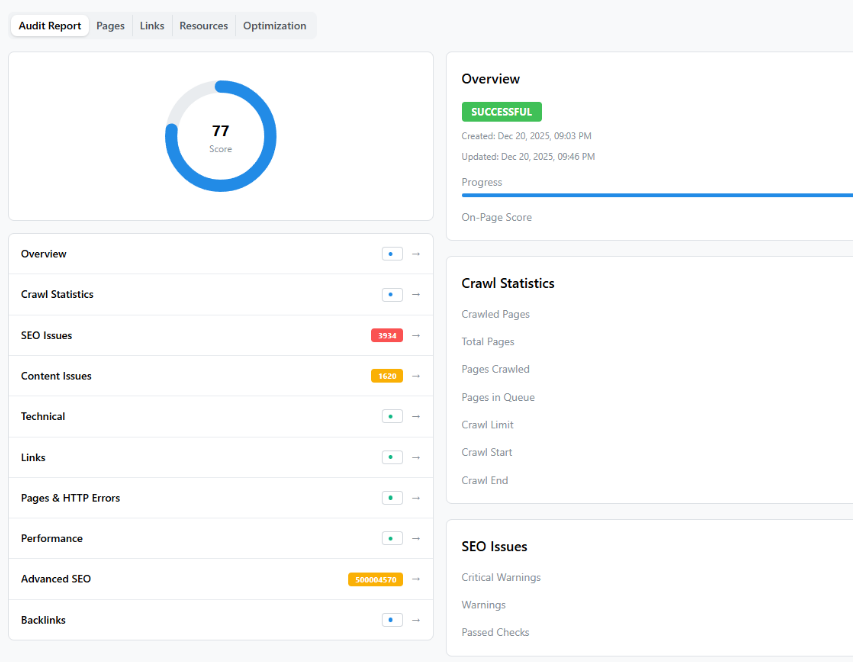
It offers real-time rank tracking, deep technical site audits, and AI search visibility metrics inside a highly intuitive dashboard.
When teams check rankings, they usually need more than a number. They need to know what moved, where it moved, which page is involved, and whether the change is broad, local, mobile-specific, or keyword-specific.
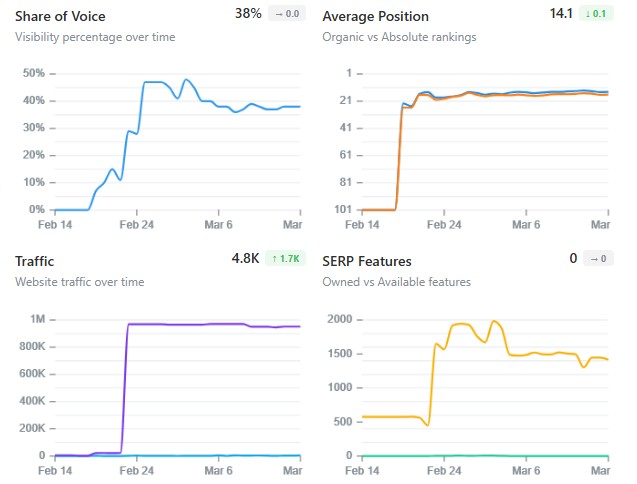
Review current rankings alongside recent shifts so you can tell whether a keyword is holding, slipping, recovering, or breaking through.
See which pages are carrying search visibility, which URLs are losing ground, and where page alignment may be limiting performance.
Check how rankings differ by location and device so you can understand whether visibility changes are broad or tied to a specific search context.
Use clearer position insight to prioritize refreshes, page updates, internal linking changes, on-page alignment, and content expansion where it matters most.
A strong seo keyword rank tracker should help you answer practical search-performance questions quickly. Where is a keyword ranking today? Has it moved in a meaningful way? Which page is attached to the ranking? Is the change showing on mobile, desktop, or in a specific location? Too often, keyword data becomes a list of positions without enough context to support real SEO decisions. A better approach keeps the ranking itself visible while also making movement, page ownership, and search placement easier to interpret.
That is the core job here. This is built for teams that want a clearer way to track seo keyword rankings, review ranking history, and understand how search visibility changes at the keyword and page level. Instead of pushing broad marketing-platform messaging, the focus stays on the exact thing users come for: understanding where SEO keywords stand in search results and what changed.
A single position check can tell you where a keyword stands right now, but it does not explain enough on its own. If a term moved from position 6 to position 11, the next question is obvious: was that a one-off shift, a broader decline, a device-specific change, or a sign that another page has become more relevant? When teams use an seo keyword rank checker, they usually need more than a snapshot. They need a readable view of movement over time.
That is why ranking visibility should be paired with context. Looking at keyword ranking changes over time helps you identify patterns instead of reacting to every fluctuation. Some movement is normal. Some movement points to a page issue, intent mismatch, stronger competition, or a search result layout change. A clear rank tracking workflow makes that distinction easier.
Keywords do not rank in isolation. Pages rank. That means any useful seo position tracker should help you connect keyword positions to the URL that is actually earning visibility. This matters for content teams deciding which page to refresh, ecommerce teams checking category and product visibility, publishers monitoring article performance, and agencies explaining ranking changes to clients.
When you can see which page is attached to a ranking, you can make better decisions faster. If the wrong page is ranking, you may have an alignment issue. If the right page is ranking but slipping, the page may need stronger on-page relevance, internal links, fresher information, or better topical support. If multiple keywords are weakening around the same page, that page becomes a clear priority.
Search placement is not always universal. A keyword may perform well on desktop but lag on mobile. It may hold steady nationally while slipping in a target city. That is why a useful google seo keyword rank tracker should support the way rankings behave in real search environments. Local and device-based position checks help you avoid false assumptions and see where visibility is genuinely strong or weak.
For local businesses, service-area companies, franchises, and multi-location brands, this is especially important. The same keyword can have very different outcomes depending on place. For mobile-heavy verticals, device differences can be just as important. Clear position checks across those dimensions help teams focus on the right pages and markets first.
A reliable search engine keyword rank tracker is not just for catching losses. It is equally useful for finding opportunities. Keywords sitting just outside the top results often represent the clearest upside. Terms that are gradually improving may need a final round of page refinement. Pages that rank for many terms but underperform on a few high-value phrases may need tighter optimization around search intent and content structure.
When ranking data is easy to read, opportunity becomes easier to prioritize. You can identify which pages are close to stronger visibility, which keywords have momentum, and where small improvements may produce outsized gains. That makes rank tracking useful not just for reporting but for planning.
SEO professionals use position tracking to validate strategy and diagnose movement. Agencies use it to communicate change clearly and prioritize client work. Founders and website owners use it to understand whether important pages are becoming more visible or losing ground. Content teams use it to measure how updates affect rankings. Ecommerce teams use it to monitor category, collection, and product search placement. Publishers use it to see where articles rise, settle, and fade.
Across all of those use cases, the need is similar: check seo keyword positions in a way that is readable, practical, and tied to the page and search context that matter. Good rank tracking removes ambiguity. It helps teams move from “something changed” to “here is what changed, here is where it happened, and here is what to do next.”
Ranking data becomes more useful when it supports action. If a cluster of keywords drops around one URL, investigate the page. If mobile rankings weaken while desktop holds, review mobile experience and SERP behavior. If local positions differ sharply by region, adjust local page targeting and relevance signals. If a page gains visibility across related terms, reinforce that momentum with supporting updates and internal links.
The point of an seo keyword rank tracker is not to create more dashboards. It is to make search placement easier to understand so your SEO work becomes more precise. Clearer ranking checks lead to better prioritization, cleaner reporting, and faster responses to shifts in search visibility.
From agencies to in-house SEO leads, the value is in making keyword positions and movement immediately understandable.
"We needed a cleaner way to explain keyword movement to clients. This made position changes easier to review because the page and ranking context stayed attached instead of getting buried."
"What stood out was how quickly we could see which keywords moved and which URLs were affected. That made content refresh decisions much more straightforward for our team."
"For ecommerce, ranking checks need to connect back to category and product pages fast. This gave us a much clearer view of where visibility was improving and where it was slipping."
"We were tired of position data that looked busy but answered very little. The search visibility view here feels practical, especially when comparing local and device-based rankings."
Straight answers for teams comparing keyword position tools and looking for clearer ranking visibility.
It is a tool used to monitor where your target keywords appear in search results and how those positions change over time.
A basic checker gives you a snapshot. A stronger setup also helps you understand movement, page-level performance, and search context behind the ranking.
Yes. Page-level visibility matters because rankings are most useful when tied to the URL earning the result.
They help you spot gains, losses, and patterns early so you can respond before visibility changes affect traffic more seriously.
Yes. Local checks help you understand how rankings differ across cities, regions, or service areas.
Yes. Device-based checks are useful because rankings can vary between mobile and desktop search results.
It is useful for SEO professionals, agencies, marketers, founders, content teams, ecommerce teams, publishers, and website owners.
Yes. Clear ranking visibility helps you decide which pages to update, which keywords to prioritize, and where search performance is changing.
The main focus is Google SEO keyword position monitoring, since that is where most teams want the clearest ranking visibility.
Look for accurate position checks, readable ranking changes, page-level context, and local or device-based visibility options.
Technical guides, ranking strategies, and expert guest posts.
Discover the top 5 AI ad generators of 2026 for SEO keyword expansion. Learn how to use SEO Keyword Rank Tracker, Jasper,...
Search visibility is easier to improve when you can see exactly where your keywords stand, how those positions move, and which pages are responsible for the result. That is the purpose of SEO Keyword Rank Tracker: a focused way to monitor keyword rankings without drifting into unrelated SEO categories or broad platform messaging. The emphasis stays on what matters most to search teams and site owners who need dependable ranking visibility.
If you need an seo keyword rank tracker that helps you review current placements, monitor changes over time, and connect keyword movement to page performance, this is the right fit. The goal is simple. Make keyword positions easier to read, make ranking changes easier to understand, and make the next SEO action easier to choose.
Checking a keyword position should not feel disconnected from the page, device, or location behind the result. A useful ranking workflow gives you more than a number in a table. It helps you understand whether a position is stable, improving, slipping, or fluctuating. It helps you see whether one page is steadily earning visibility or whether another URL has started taking over. It helps you review whether movement is broad or limited to mobile, desktop, or a specific local market.
That is why the experience here is centered on practical ranking interpretation. Teams often need to track seo keyword rankings not only for reporting but for diagnosis and prioritization. When positions shift, the real question is what changed and what deserves attention first. Cleaner visibility makes that answer easier to reach.
A standard seo keyword rank checker can tell you where a term ranks today. A better one helps you use that information well. If a keyword rises from page two to the edge of page one, that may signal a near-term opportunity. If a group of terms tied to the same landing page drops together, that may point to a page-level issue. If local rankings weaken in one city but hold in another, that may change how you prioritize updates. These are the kinds of decisions that rank tracking should support.
For agencies, this means clearer client communication. For in-house teams, it means more confident prioritization. For founders and website owners, it means knowing whether search visibility is actually improving on the pages that matter most. For content teams, it means understanding whether updates create measurable movement in rankings. For ecommerce teams, it means seeing how category and product pages perform for the search terms that drive discovery.
Keyword rankings are not always uniform. Search results can change based on device type and local context, which means a position check without those dimensions may miss part of the story. A keyword that performs well on desktop may underperform on mobile. A page that ranks strongly in one market may struggle in another. This is why the ability to check seo keyword positions with added context matters so much.
Location-aware and device-aware rank monitoring helps teams separate broad SEO issues from narrower visibility shifts. That leads to better interpretation and better action. Instead of overreacting to a single data point, you can identify whether a change is isolated or widespread. That makes your optimization work more precise and your reporting more credible.
Tracking positions is most valuable when it leads to practical next steps. If rankings are improving around a page, you may want to reinforce that momentum with supporting content, internal links, or expanded coverage. If they are slipping, you may need to revisit intent alignment, page structure, freshness, or topical depth. If a keyword is stuck just outside stronger positions, small improvements may be enough to move it into a more competitive range.
That is where keyword ranking changes become genuinely useful. They help you identify which pages need protection, which opportunities are close to breaking through, and which parts of your site are losing search traction. The clearer the movement is, the easier it becomes to choose the next SEO task with confidence.
One of the most common problems in rank tracking is losing the page-level connection. A keyword moved, but which URL is involved? Is it the intended page? Is the ranking page stable? Are multiple pages competing for the same term? Those questions matter because rankings are ultimately earned by pages, not by keywords alone. A better seo position tracker keeps that relationship visible.
By keeping keyword positions tied to page performance, teams can diagnose issues faster. You can spot when the wrong page is ranking, when a target page is weakening, or when one URL is carrying more visibility than expected. That creates a much stronger foundation for content updates, page consolidation, internal linking changes, and on-page optimization work.
This site is intentionally narrow in a good way. It is not trying to be a broad SEO suite, a backlink product, a technical audit center, or a generic analytics layer. It stays focused on the need behind the visit: understanding keyword positions in search and monitoring how they change. That makes it especially useful for people who want a search engine keyword rank tracker experience that remains tightly aligned with search placement and page-level SEO performance.
Whether you manage a content-heavy publication, a growing ecommerce catalog, a local business site, a SaaS website, or a portfolio of client properties, the same principle applies. Better ranking visibility leads to better SEO choices. When positions are easier to read, movement is easier to explain, and page ownership is easier to verify, your optimization work becomes more targeted and more effective.
Teams choose this approach because it keeps the signal strong. The focus stays on current rankings, movement over time, page-level visibility, local and device-based differences, and the practical decisions that follow. If you need a google seo keyword rank tracker that helps you move from raw ranking data to useful search insight, this is built around that exact job.
Use it to review important keywords, monitor search placement shifts, identify page-level strengths and weaknesses, and keep SEO reporting grounded in real visibility changes. When ranking checks are clear, the work that follows gets better.

From quick checks to ongoing monitoring, the focus stays on where keywords rank, how visibility changes, and what those shifts mean for the page behind the keyword.
Track competitor keyword rankings, movement, ranking pages, and Top 100...
Track keyword rankings daily to spot movement, monitor Top 100...
Track keyword rankings daily to catch movement early, monitor page...
Desktop keyword position tracker guide for SEO teams. Learn how...
Desktop keyword rank checker guide for SEO teams: track keyword...
Check which keywords a domain ranks for, track movement across...
See where keywords rank, how positions move, and which pages need attention so your next SEO decision is based on clear search placement data.